
Building acoustics measurements
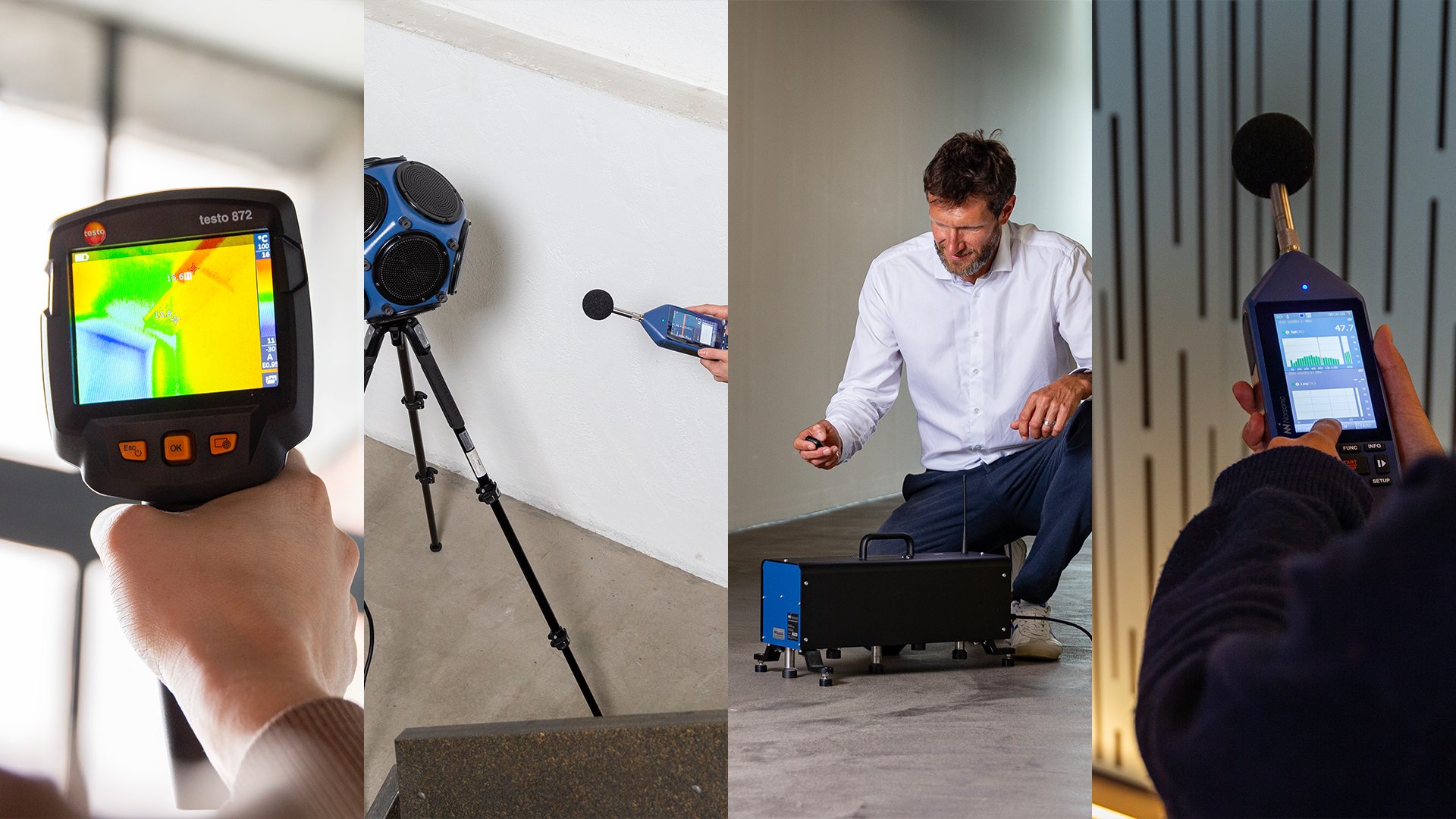
Building acoustics covers protection against both internal and external noise. Measurements of airborne and impact sound are used to assess the quality of sound insulation and verify compliance with applicable acoustic requirements and standards. These measurements are generally carried out as part of quality control before a property is occupied, or in response to requests from residents. They provide information on the sound insulation between adjoining units.
Room acoustics measurements
Room acoustics play a significant role in the design of schools, nurseries, auditoriums, multi-purpose halls and sports halls. Reverberation time, speech intelligibility and sound absorption coefficients are the key parameters. In addition, distraction distance and privacy distance are becoming increasingly important in hospitals, office buildings and open-plan offices. These measurements provide information on the sound absorption characteristics of a room.
Noise from building services systems
Noise from building services systems, such as lifts in operation, neighbouring sanitary facilities, ventilation outlets or cracking sounds caused by material stresses, can be audible and may cause disturbance. Appropriate measurements assess the quality of workmanship and the vibration isolation of systems rigidly connected to the building structure. Compliance with relevant standards is also assessed.
Noise emissions from building services systems
Heating, ventilation, air conditioning and plumbing (HVAC and plumbing)
Technical installations can generate disturbing noise emissions. Examples include heat pumps with inadequate vibration isolation, where vibrations are transmitted to the building structure and radiated as structure-borne noise. Poorly secured pipework can cause similar problems, with vibrations transmitted through the building fabric. Direct airborne sound transmission can also contribute to noise disturbance.
Sound power level measurements support early-stage planning and enable the precise design of noise control and vibration isolation measures.
Moisture measurements
Freedom from mould and condensation
Whether on a construction site, during refurbishment, or in new or existing buildings, excessive moisture can compromise both the integrity of the building and the health of its occupants. Early detection is therefore essential. In particularly critical cases, mould growth and more serious moisture-related damage can threaten the stability and safety of building structures, potentially making extensive and costly remediation unavoidable.
Thermal imaging
Thermal imaging camera
In the construction industry, thermal imaging is a highly effective tool for accurately identifying weaknesses in building insulation, air leaks around windows and doors, and moisture-related issues. The resulting data enables a detailed analysis, providing the basis for targeted measures to improve energy efficiency and prevent damage.
These measures can enhance building performance while allowing potential defects to be detected and addressed at an early stage. This helps prevent long-term damage and extend the service life of buildings.